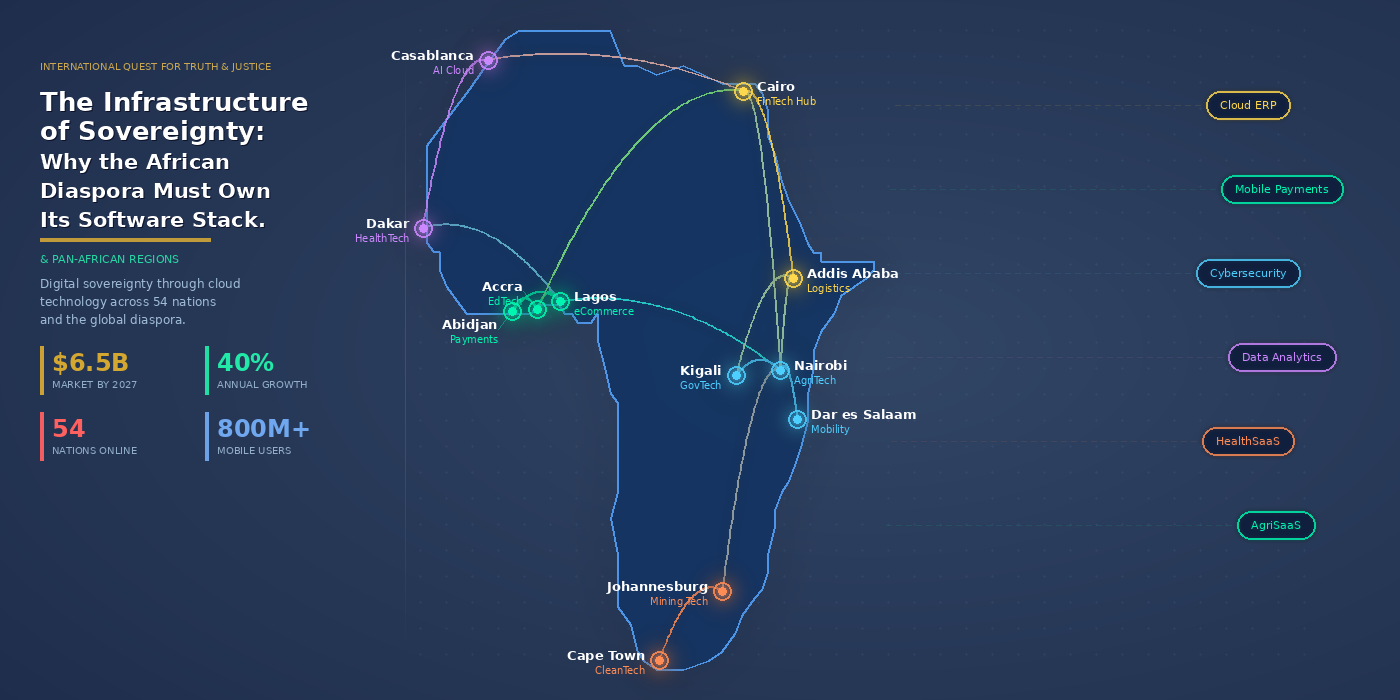
The Infrastructure of Sovereignty:
Why the African Diaspora Must Own Its Software Stack
International Quest for Truth & Justice | 'IQTJ Codex Series'
There is a principle at the heart of every empire: control the tools and you control the people who use them. The printing press. The ledger. The shipping manifest. The algorithm. Each age produces a new architecture of power, and those who own that architecture shape what is possible for everyone else.
We are living through a decisive moment in that long story. Software-as-a-Service - SaaS - has become the invisible infrastructure of the modern economy. From healthcare records to supply chains, from education platforms to agricultural logistics, the way goods, services, knowledge, and capital move through the world now runs through cloud-based software networks owned predominantly by a handful of corporations headquartered in Silicon Valley, London, and Beijing.
For Africa, the Caribbean, Brazil, and Haiti, this is not a neutral fact. It is a fork in the road.
What Is at Stake
SaaS is not just a technology category. It is an organizational substrate, the connective tissue that allows businesses, governments, NGOs, and communities to coordinate at scale. When that substrate is owned by parties whose interests are not aligned with yours, you are building your sovereignty on someone else’s foundation.
Consider what this means in practice across the diaspora geographies IQTJ is committed to:
Africa
Africa is home to the fastest-growing population of entrepreneurs and technology users on the planet. Yet the continent’s digital economy runs disproportionately on infrastructure it does not own, payment rails, logistics software, HR systems, CRM platforms, all extracting data and value upward and outward. Africa is generating the content, the commerce, the creativity. But the pipes? The pipes belong to others.
The Caribbean
The Caribbean faces a specific compounding challenge: small island economies dispersed across thousands of miles of ocean, each with distinct regulatory environments, colonial inheritances, and limited internal markets. SaaS, properly designed and community-governed, could be the connective tissue that finally allows Caribbean nations to coordinate as an economic bloc, to share healthcare systems, agricultural data, tourism infrastructure, and educational resources at a scale that individual islands cannot achieve alone.
Brazil
Brazil, with the world’s largest population of African descent outside the continent itself, sits at a crossroads. The country has significant domestic tech infrastructure, but Afro-Brazilian communities, concentrated in the Northeast, in favelas, in rural quilombos, have largely been excluded from the ownership class of that infrastructure. The tools are there. The question is who they serve and who controls them.
Haiti
Haiti, the nation that gave the world its first proof that enslaved people could free themselves and build a sovereign state, has been systematically deprived of the material and digital infrastructure that sovereignty requires. Haiti’s development challenge is not a lack of human capacity, it is a sustained, centuries-long suppression of the material conditions for coherence. SaaS and digital networks alone will not fix that. But intentional, sovereignty-first technology deployment can be part of restoring what was deliberately broken.
The Rise of Diaspora-Aligned SaaS
What is new, and urgently important, is that this moment is also producing something different: the rise of SaaS tools, platforms, and networks built by and for African and diaspora communities.
This is not charity. It is correction.
Finance and Payments
Platforms like Flutterwave, Chipper Cash, and Wave have demonstrated that African-built payment infrastructure can outperform legacy systems in speed, cost, and cultural fit. The remittance corridor between the diaspora and the continent, worth over $100 billion annually, is being reclaimed from the extractive fee structures of Western Union and MoneyGram. This is SaaS as reparative economics.
Agriculture and Land
Platforms mapping land use, digitizing titling, and connecting smallholder farmers to markets, from Twiga Foods in East Africa to AgroFides in Haiti’s agricultural corridor, demonstrate that software built with local knowledge produces better outcomes than software parachuted in. When a farmer in the Artibonite Valley or the Sahel can see real-time pricing, access micro-insurance, and verify their land title through a platform built with their needs as the primary design constraint, that is sovereignty in practice.
Health
Community health networks across West Africa, the Eastern Caribbean, and Brazil’s SUS public health system are deploying SaaS platforms for patient records, supply chain management, and telehealth that are governed by the communities they serve. The difference between a health platform controlled by a diaspora health cooperative and one controlled by a multinational health-tech company is not just philosophical, it is the difference between a tool that serves you and a tool that studies you.
Education
From Nairobi to Kingston to São Paulo, community-built learning platforms are encoding not just curriculum content but epistemology, ways of knowing that center African and diaspora intellectual traditions. This is the digital dimension of what the Codex framework calls the restoration of coherence: rebuilding the signal that colonial distortion suppressed.
The Networks Are the New Infrastructure
Beyond individual platforms, the most significant development is the emergence of networks, consortia, cooperatives, and federated systems, that allow diaspora communities to share infrastructure without surrendering ownership of it.
The Pan-African Payment and Settlement System (PAPSS), launched by the African Union and Afreximbank, is building a continent-wide interbank payment network that bypasses the dollar-denominated correspondent banking system. This is not a small thing. Every dollar-denominated transaction on the continent has been a form of tribute. PAPSS is an architectural challenge to that tribute.
The Caribbean Community (CARICOM) is moving, slowly, but moving, toward shared digital infrastructure across its fifteen member states. A shared digital identity framework, a unified agricultural data network, a Caribbean cloud: these are the building blocks of a sovereignty that has been theorized for decades and is now technically achievable.Diaspora tech networks, from African diaspora investment funds in Atlanta and London to Haitian tech ecosystem catalysts like Banj and the Wynne Farm creative tech hub, are developing not just platforms but pipelines: connecting capital, talent, and governance frameworks so that the next generation of software is built for coherence, not extraction.
The Codex Principle: Eliminating Distortion at the Infrastructure Level
The IQTJ Codex framework names distortion as the core mechanism of suppression, the ways in which the signal of a community’s coherence, sovereignty, and self-knowledge is interrupted, corrupted, and redirected. For too long, technology has been a vector of that distortion: credit algorithms that encode redlining, facial recognition that misidentifies Black faces, social media systems that amplify division and suppress organizing.
SaaS built for and by diaspora communities is an act of distortion elimination. It means insisting that the software layer of civilization reflect the coherence of the people it serves, their kinship networks, their oral governance traditions, their land relationships, their collective economic practices. It means governance structures for technology that look more like cooperative ownership than venture capital extraction.
This is not anti-technology. It is pro-sovereignty.
What Is Needed Now
The moment calls for intentionality across five urgent lanes:
Interoperability Standards. So that Haitian, Caribbean, Brazilian, and African SaaS platforms can communicate and coordinate without requiring dependency on Western middleware.
Diaspora-Governed Cloud Infrastructure. Physical and virtual data centers owned by and accountable to diaspora communities, so that the data generated by these communities is not a resource extracted by others.
Open-Source Foundations. Prioritizing open-source development for core infrastructure (health records, land registries, educational platforms) so that no single corporate actor can hold a community’s foundational systems hostage.
Regulatory Sovereignty. Ensuring that African Union, CARICOM, and Brazilian digital policy frameworks actively support diaspora-aligned SaaS development rather than defaulting to frameworks written in Brussels or Washington.
Investment Pipelines. Directing diaspora capital, a genuinely massive and underdeployed resource — into the technology infrastructure of the communities that capital represents.
Conclusion: Build the Foundation or Rent It Forever
There is a moment in every reconstruction when the question becomes: are we rebuilding what was, or are we building what should be?
The African diaspora, from Accra to Port-au-Prince, from Salvador da Bahia to Bridgetown, is at that moment with digital infrastructure. The tools exist. The talent exists. The need is urgent and the opportunity is real.
The question is whether the communities that need sovereignty-aligned software will build it, govern it, and own it, or whether they will once again rent access to systems whose first loyalty is elsewhere.
IQTJ holds that sovereignty is not a destination. It is a practice. And in 2026, that practice must include the software stack.
References
Finance & Payments
[1] Flutterwave
Flutterwave, Inc.
Pan-African payments infrastructure company enabling cross-border transactions across 34+ African countries. Referenced in context of African-built payment rails reclaiming the remittance corridor.
[2] Chipper CashChipper Technologies, Inc.
Mobile-based, no-fee peer-to-peer payment platform operating across sub-Saharan Africa and the diaspora. Referenced as an example of diaspora-aligned fintech displacing extractive transfer services.
[3] Wave Mobile Money
Wave, Inc.
Low-cost mobile money platform operating in West Africa (Senegal, Côte d'Ivoire, Burkina Faso, Uganda, Mali). Referenced in context of affordable African-owned payment infrastructure.
Agriculture & Land
[4] Twiga Foods
Twiga Foods Ltd.
Kenyan B2B food distribution platform connecting smallholder farmers to urban markets via mobile technology. Referenced as an example of African-built agricultural SaaS creating sovereignty-aligned supply chains.
[5] AgroFides / Haiti Agricultural Corridor
Various implementing partners; Artibonite Valley, Haiti
Agricultural technology and cooperative finance initiatives operating in Haiti's Artibonite Valley — the country's primary rice-producing region. Referenced in context of sovereignty-first agricultural software deployment in Haiti.
https://www.ifad.org/en/web/operations/w/country/haiti
Continental & Regional Infrastructure
[6] Pan-African Payment and Settlement System (PAPSS)
African Export-Import Bank (Afreximbank) & African Union
Continent-wide interbank payment network enabling intra-African trade settlement in local currencies, bypassing dollar-denominated correspondent banking. Launched 2022. Referenced as a structural challenge to dollar-tribute extraction from African commerce.
[7] CARICOM — Caribbean CommunityCaribbean Community Secretariat
Intergovernmental organization of 15 Caribbean member states. Referenced in context of emerging shared digital infrastructure including digital identity frameworks and unified agricultural data networks.
Haiti Tech Ecosystem
[8] Banj
Banj Haiti
Haiti-based tech hub and startup accelerator fostering local technology entrepreneurship and innovation. Referenced as a diaspora tech network catalyst connecting capital and talent.
[9] Wynne Farm Ethical Technology Center
Wynne Farm, Port-au-Prince, Haiti
Creative technology and ethical innovation hub in Haiti. Referenced as an example of community-rooted tech infrastructure development in the Haitian ecosystem.
Brazil
[10] SUS — Sistema Único de Saúde (Unified Health System)
Brazilian Ministry of Health
Brazil's national public health system — one of the world's largest. Referenced in context of public health SaaS deployment and the potential for community-governed health data platforms serving Afro-Brazilian populations.
https://www.gov.br/saude/pt-br/acesso-a-informacao/acoes-e-programas/sus